
King of Cups
kingminor-arcana · Cups
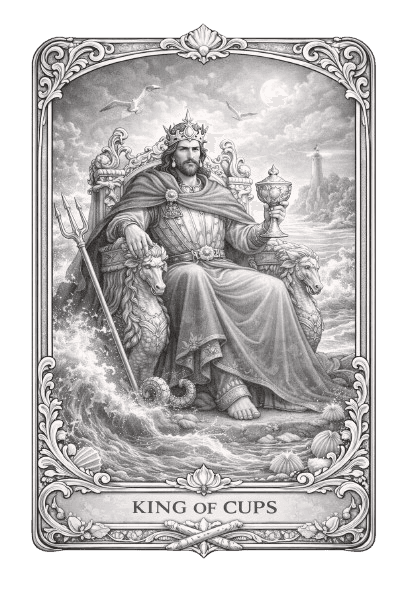
Explore the meaning of the King of Cups tarot card. Discover what this card means in both upright and reversed positions.
Upright Meaning
Meaning
UprightKing of Cups upright steadies the room like a harbor wall—feelings run deep, yet the surface stays navigable. This is leadership that can sit with grief in a meeting and still choose a fair next step. When you draw him, practice responding instead of reacting: breathe, name what is true, act without using emotion as a weapon.
Keywords
- compassion
- leadership
- harmony
- nurturing
- guidance
- emotional mastery
- stability
- empathy
Love
In love, King of Cups upright favors partners who show up emotionally literate—listening without fixing, apologizing without theatrics. If you are single, become the person who can hold depth without drama; if partnered, offer calm when storms hit.
Career
At work, King of Cups upright suits mediation, healthcare, creative direction, and any role where trust is currency. Your calm is contagious; document decisions so kindness is not mistaken for vagueness.
Spiritual
Spiritually, King of Cups upright blesses mentors who stay when others leave. Seek one, or be one—with boundaries intact.
Advice
Content coming soon.
Reversed Meaning
Meaning
ReversedThe reversed King of Cups speaks of a fractured emotional landscape, a stark contrast to the compassionate authority he embodies upright. Imagine the great Venetian canals, once bustling with trade and diplomacy, suddenly choked with a thick, unsettling fog – that’s the feeling this card conveys. It’s not merely about sadness, but a palpable absence of emotional availability. A father, typically a source of comfort and guidance, becomes distant and critical; a therapist, renowned for their empathy, offers only clinical detachment; a friend, once a reliable shoulder to cry on, turns away with an inexplicable coolness. This isn't a failing of character, necessarily, but a symptom of an internal crisis. Historically, the role of a royal advisor—often a figure akin to the King of Cups—required a remarkable ability to navigate complex court politics with grace and understanding. A reversed King suggests this ability has been compromised, perhaps by a history of betrayal or a profound disillusionment. The capacity for nuanced emotional response is constricted, manifesting as abrupt dismissals, an inability to validate another’s feelings, or a tendency to intellectualize emotions rather than engage with them. It’s as if a vital circuit has broken, preventing the flow of emotional connection. This card urges a careful examination of past experiences – particularly those involving emotional vulnerability – to identify the root of this protective emotional barrier and to begin the slow, deliberate work of re-establishing trust and emotional openness.
Keywords
- imbalance
- conflict
- unresolved
- overwhelm
- lack of control
- stagnation
- self-sabotage
- guarded
Love
Reversed, the King of Cups suggests a relationship subtly undermined by a lack of genuine feeling. Picture a Florentine workshop, famed for its exquisite craftsmanship, where a master artisan deliberately uses inferior pigments to disguise a structural weakness – that’s the dynamic at play. Instead of overt conflict, there's a pervasive sense of emotional distance, a withholding that feels less like malice and more like ingrained habit. Perhaps affection is offered only when convenient, or empathy reserved for specific, performative moments. This can create a climate of uncertainty, where one partner constantly gauges the other’s mood, a subtle tension echoing the anxieties of households during the Italian Wars. It's a signal to investigate the roots of this guardedness; it may stem from a learned behavior—a fear of appearing weak, or a desire to maintain control—and to address it with courage and directness, even if it risks exposing uncomfortable patterns.
Career
The reversed King of Cups in a career context reveals a subtle but corrosive loss of professional standing. Think of the Dutch Golden Age, when the Vereenigde Oostindische Compagnie – the VOC – relied on the quiet diplomacy of its regents to navigate complex trade disputes. A single misstep, a perceived lack of emotional intelligence, could jeopardize years of negotiation. You may be facing a similar dynamic now, where your professional value is undermined by a hesitancy to express dissenting opinions or enforce boundaries. This might appear as a pattern of accepting tasks outside your remit, mediating conflicts without addressing root causes, or deferring crucial decisions to avoid discomfort. The consequence isn't overt failure, but a gradual dilution of your authority and a sense of detachment from your work's impact. Observe where your desire to maintain a pleasant atmosphere is inadvertently enabling inefficiency or inequity, and identify a specific, actionable step – perhaps requesting a formal role clarification or scheduling a direct conversation – to reclaim your professional agency.
Spiritual
Reversed, the King of Cups suggests a retreat from emotional responsibility, a deliberate closing off. Think of the Venetian *mascarade* tradition, where elaborate masks concealed identity and emotion—a similar tactic may be at play. It isn't necessarily a rejection of connection, but a survival strategy developed in response to past hurt. Perhaps a figure of authority, meant to provide stability, instead inflicted emotional pain, leaving a legacy of guardedness. This manifests as an inability to offer solace, like a craftsman who, after a kiln failure destroyed a lifetime’s work, refuses to teach an apprentice. The posture becomes rigid; a hand outstretched to help feels heavy, unresponsive. To reawaken compassion, focus on concrete gestures: preparing a simple meal for someone grieving, tending a neglected garden—observe the subtle shifts in physical tension: the uncurling of fingers, a lessening of the furrow in the brow.
Advice
Content coming soon.